
Social Awareness Model
A structured approach to identifying community concerns, developing reliable awareness messages, engaging people, and supporting positive community action.
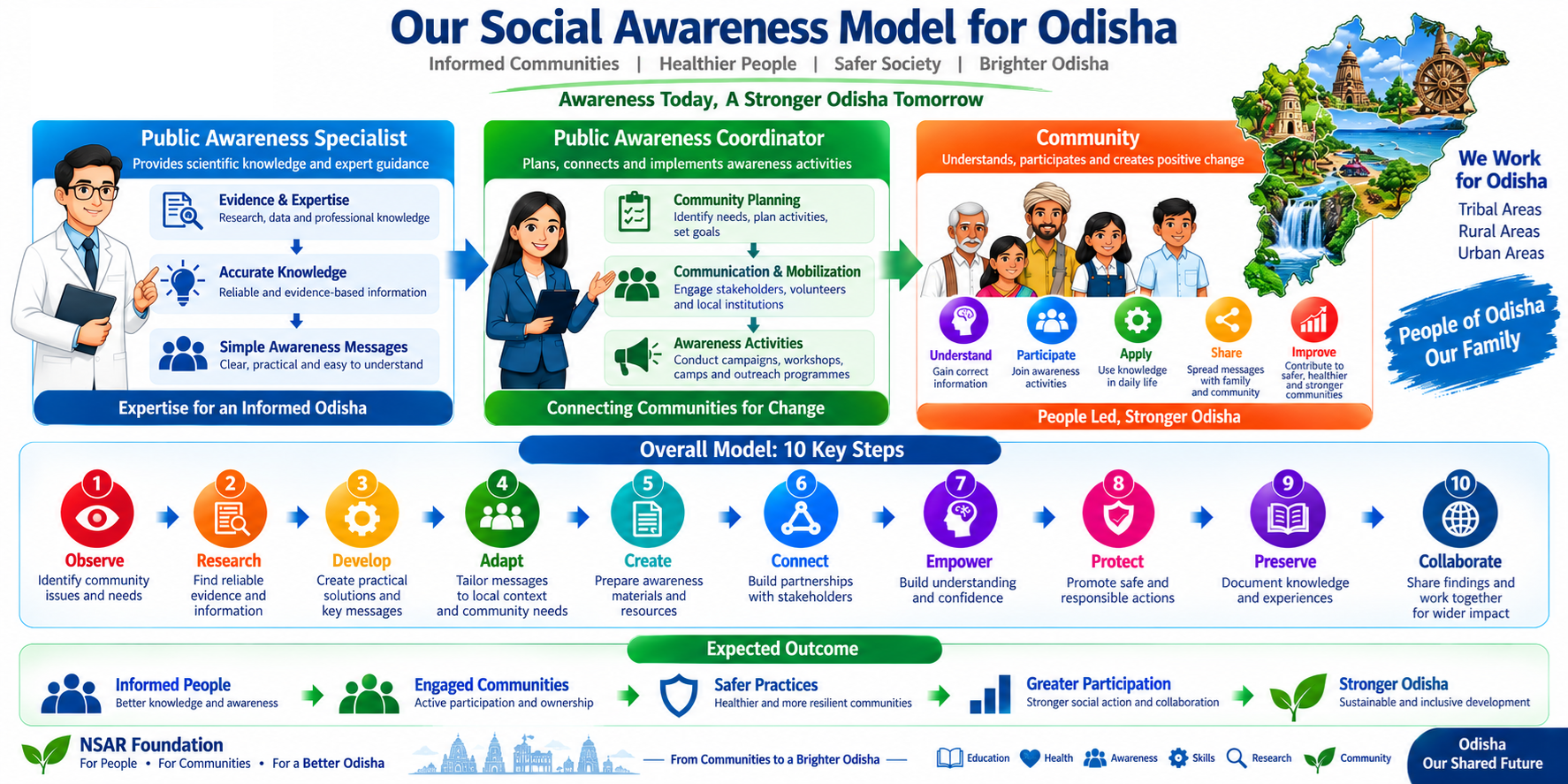
NSAR Foundation Social Awareness Model — From evidence and knowledge to community engagement and positive action.
Our Community Social Awareness Model
The NSAR Foundation Social Awareness Model provides a simple, structured approach for identifying community concerns, developing reliable awareness messages, engaging people, and supporting positive community action. The model can be adapted for tribal, rural, and urban communities.
10-Step Community Awareness Model
The model moves from understanding community needs to evidence, communication, participation, protection, documentation, and wider collaboration.
Observe — Understand the Community
Identify important social, health, educational, environmental, and safety concerns through community interaction, field observation, and available evidence.
Research — Understand the Issue
Collect and review reliable information from scientific literature, government sources, experts, and community-level evidence.
Develop — Create Practical Solutions
Convert reliable information into simple, practical, and culturally appropriate awareness messages and activities.
Adapt — Make Awareness Community-Specific
Adapt messages according to language, culture, literacy level, local needs, and social context.
Create — Prepare Awareness Materials
Develop easy-to-understand posters, leaflets, videos, presentations, social-media content, workshops, and educational resources.
Connect — Build Partnerships
Connect with teachers, health workers, social workers, researchers, local leaders, volunteers, institutions, and community organizations.
Empower — Build Understanding
Encourage people to ask questions, understand evidence, recognize misinformation, make informed decisions, and participate in community activities.
Protect — Promote Safe and Responsible Action
Help communities recognize risks, avoid harmful misinformation, use reliable information, and adopt appropriate preventive and responsible practices.
Preserve — Document Knowledge and Experience
Record awareness activities, educational materials, community feedback, lessons learned, and outcomes for future programmes and research.
Inform & Collaborate — Share and Improve
Share experiences, findings, educational resources, and successful approaches with relevant professionals, institutions, government bodies, and recognized organizations.
Roles in the Awareness Model
Effective public awareness requires both professional expertise and strong community coordination.
Public Awareness Specialist
The Public Awareness Specialist provides the scientific and professional foundation of the programme.
- Identifies important awareness topics.
- Reviews reliable evidence and information.
- Develops scientifically accurate messages.
- Converts technical information into simple public language.
- Guides awareness materials and educational content.
- Provides technical training and guidance.
- Supports quality assurance and impact evaluation.
Public Awareness Coordinator
The Public Awareness Coordinator connects the awareness programme with communities and supports implementation.
- Identifies and communicates with local stakeholders.
- Plans awareness activities.
- Coordinates schools, communities, institutions, volunteers, and local organizations.
- Organizes camps, workshops, meetings, and outreach activities.
- Communicates messages in appropriate local languages.
- Collects community feedback.
- Documents activities and reports outcomes.
From Awareness to Community Action
The model connects evidence, professional expertise, community coordination, and public participation to support informed, responsible, and sustainable community action.
Free Digital Education Model
A bilingual educational model connecting Odisha's language, culture, traditions, Indian Knowledge Systems, nature, health, practical skills and digital learning for children and communities.
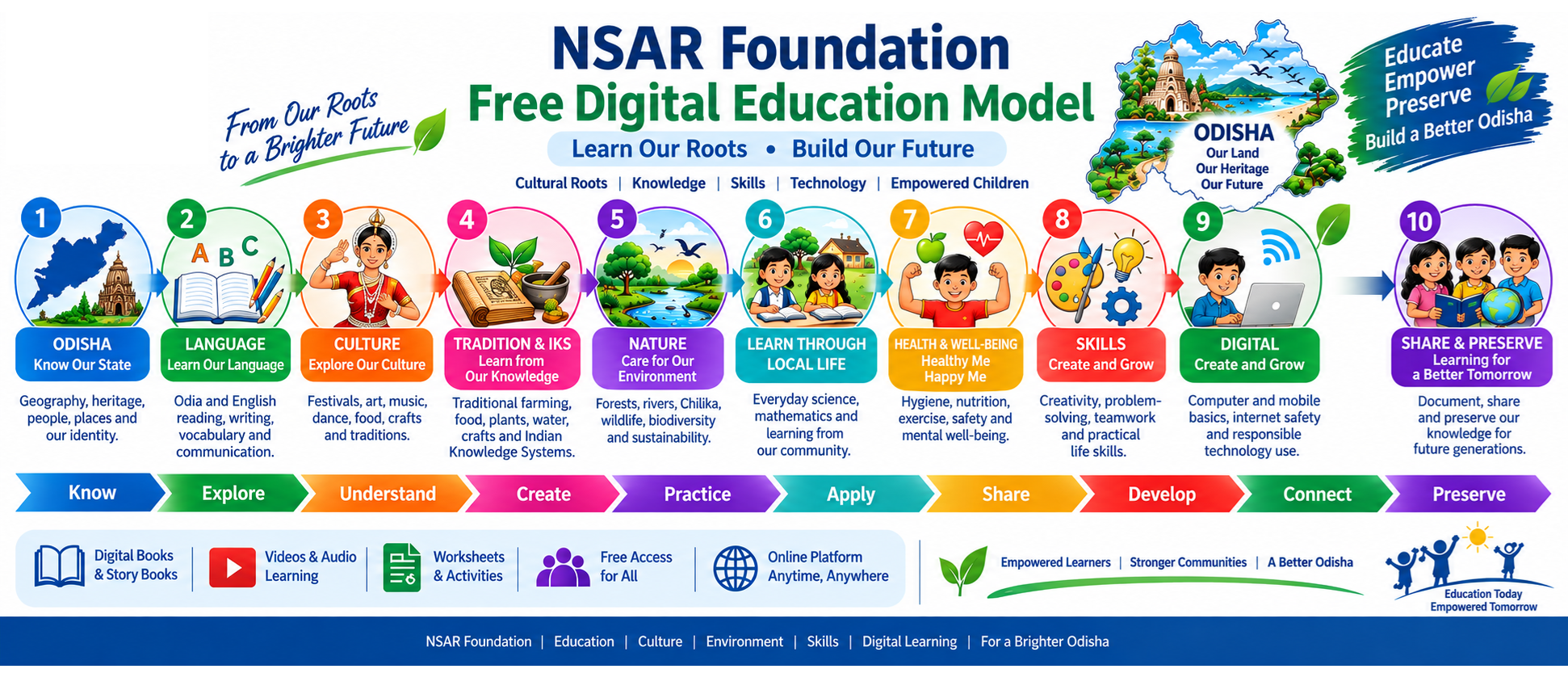
Our Free Digital Education Model
The NSAR Foundation Free Digital Education Model is designed to provide accessible, child-friendly educational resources in Odia and English, with a strong focus on Odisha's identity, language, culture, traditions, environment, traditional knowledge and Indian Knowledge Systems (IKS).
The model connects local knowledge with modern learning, helping children learn about their surroundings while developing literacy, creativity, scientific thinking, digital awareness and practical life skills.
↓
Understand Our Heritage
↓
Learn from Our Knowledge
↓
Develop Skills
↓
Build the Future
10-Point Free Digital Education Model
A structured learning pathway connecting Odisha's identity and heritage with education, skills, health and responsible digital learning.
Know Odisha
ଓଡ଼ିଶାକୁ ଜାଣିବା
Introduce children to Odisha's:
- Geography and regions
- Districts and important places
- State symbols
- Historical places
- Important personalities
- Communities and local life
- Natural and cultural diversity
Learn Odia Language
ଓଡ଼ିଆ ଭାଷା ଶିକ୍ଷା
Develop age-appropriate resources for learning:
- Odia letters and vocabulary
- Reading and writing
- Stories and poems
- Children's literature
- Local words and expressions
- Bilingual Odia-English learning
- Communication skills
Explore Odisha's Culture
ଓଡ଼ିଶାର ସଂସ୍କୃତିକୁ ଜାଣିବା
Introduce children to Odisha's rich cultural heritage through:
- Jagannath culture
- Festivals
- Folk traditions
- Dance and music
- Handicrafts
- Traditional art
- Food traditions
- Local customs and community practices
Discover Traditional Knowledge & IKS
ପାରମ୍ପରିକ ଜ୍ଞାନ ଓ IKS ଆବିଷ୍କାର
Introduce children to age-appropriate aspects of Indian Knowledge Systems (IKS) and locally documented knowledge, including:
- Traditional agriculture
- Food knowledge
- Indigenous plants
- Water conservation practices
- Traditional crafts
- Local technologies
- Community knowledge
- Nature-based practices
- Traditional ecological knowledge
Discover Odisha's Nature
ଓଡ଼ିଶାର ପ୍ରକୃତିକୁ ଜାଣିବା
Children learn about:
- Forests
- Rivers
- Wetlands
- Chilika
- Coast and marine ecosystems
- Wildlife
- Birds
- Biodiversity
- Local plants
- Environmental protection
Learn Through Local Life
ସ୍ଥାନୀୟ ଜୀବନରୁ ଶିକ୍ଷା
Connect school learning with children's everyday surroundings.
- Mathematics through markets and farming
- Science through water, soil and plants
- Language through local stories
- Geography through villages and districts
- Environmental science through local ecosystems
- Social science through community life
Learn Health, Safety & Well-being
ସ୍ୱାସ୍ଥ୍ୟ, ସୁରକ୍ଷା ଓ ସୁସ୍ଥ ଜୀବନ
Develop simple educational resources on:
- Personal hygiene
- Healthy food
- Nutrition
- Physical activity
- Sleep
- Mental well-being
- Personal safety
- Environmental health
- First-aid awareness
- Responsible health information
Build Creativity & Practical Skills
ସୃଜନଶୀଳତା ଓ ବ୍ୟାବହାରିକ ଦକ୍ଷତା
Encourage:
- Drawing
- Storytelling
- Problem-solving
- Communication
- Teamwork
- Creative thinking
- Simple experiments
- Arts and crafts
- Practical activities
- Project-based learning
Digital Literacy & Safe Technology
ଡିଜିଟାଲ ସାକ୍ଷରତା ଓ ସୁରକ୍ଷିତ ପ୍ରଯୁକ୍ତି ବ୍ୟବହାର
Provide age-appropriate learning about:
- Mobile and computer basics
- Digital learning
- Internet safety
- Privacy
- Cyberbullying awareness
- Misinformation awareness
- Responsible social media use
- Digital citizenship
- Safe online communication
Learn, Share & Preserve
ଶିଖିବା, ବାଣ୍ଟିବା ଓ ସଂରକ୍ଷଣ କରିବା
Encourage children and communities to:
- Learn local knowledge
- Document stories and traditions
- Record community experiences
- Share educational resources
- Preserve language and cultural heritage
- Participate in projects
- Create digital learning materials
- Connect local knowledge with wider education
The Learning Flow
Bilingual Learning Approach
Educational resources can be developed according to the learning needs and language preferences of children and communities.
ଓଡ଼ିଆ
For children and communities who prefer learning in the Odia language.
English
For wider educational access and bilingual learning.
Odia + English
For vocabulary development, language comparison and gradual bilingual learning.
Proposed Digital Resource Formats
Accessible educational resources designed for children, parents, teachers and communities.
Educational Series
Proposed Nursery-to-Primary learning resources connecting local knowledge, culture and modern education.
Free Access Model
Educational resources can be made available through the NSAR Foundation website and digital platforms, with free access for learners, parents, teachers and communities, subject to the project's publication and copyright terms.
Our Educational Principle
“Every child should have an opportunity to learn, explore and understand their language, culture, environment, community and the wider world.”
Social Survey & Community Research Model
A structured approach to understanding community needs, social conditions, service access, institutional performance and local challenges through systematic field-based data collection.
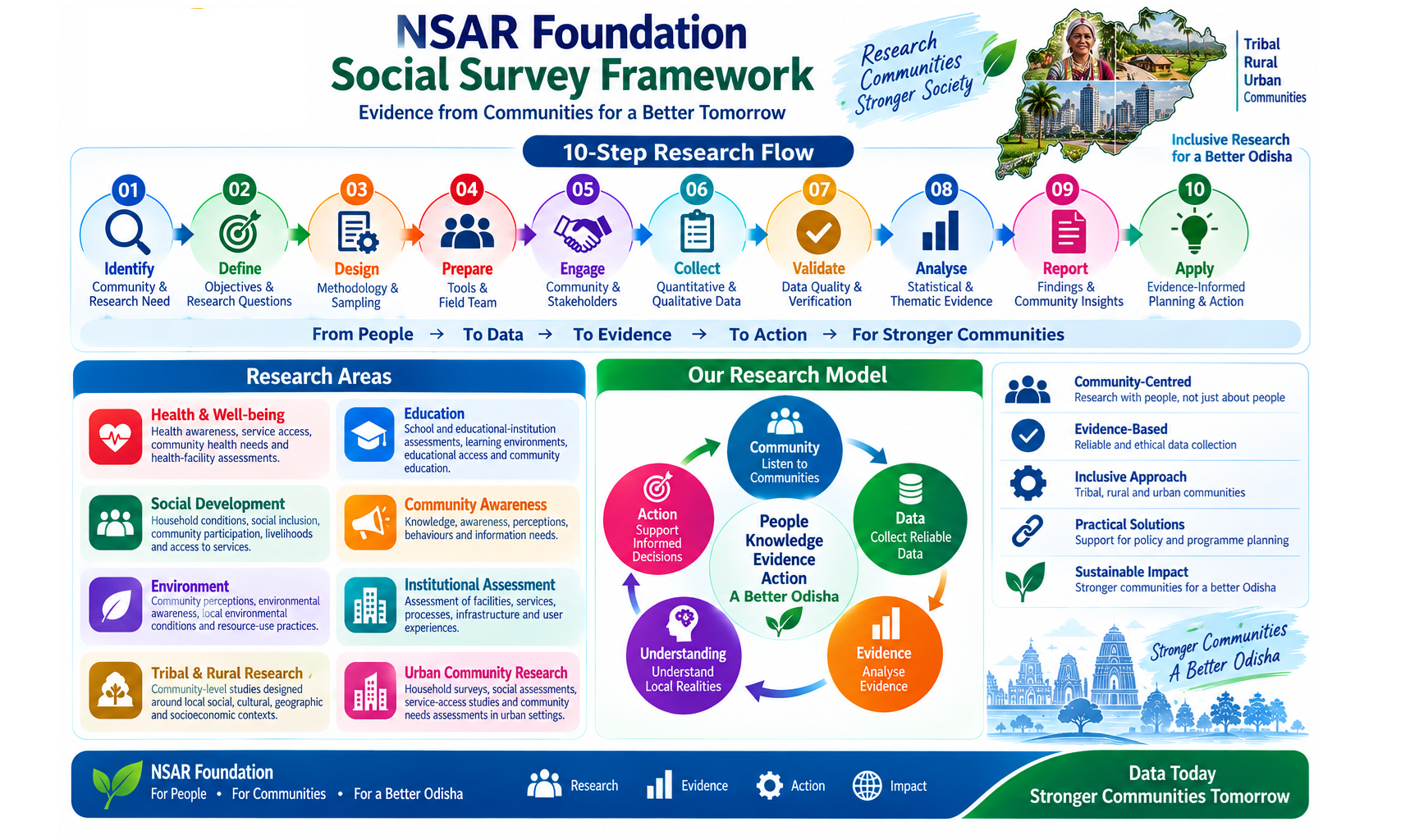
Community-Centred Research
The NSAR Foundation Social Survey and Community Research Model combines quantitative and qualitative research methods to generate reliable, context-specific evidence from tribal, rural and urban communities.
Two Complementary Research Methods
Quantitative and qualitative approaches can be combined according to the objectives, population and design of each study.
Quantitative Data Collection
Measure Community Conditions
Quantitative research generates structured and measurable information that can be analysed statistically.
- Household surveys
- Social surveys
- Community needs assessments
- Baseline and endline surveys
- Screening surveys
- Health and educational surveys
- Facility assessments
- KAP surveys
- Monitoring surveys
- Service-access assessments
Qualitative Research
Understand Experiences & Community Perspectives
Qualitative research helps explain experiences, perceptions, behaviours, needs and challenges behind numerical findings.
- In-depth Interviews (IDIs)
- Focus Group Discussions (FGDs)
- Key Informant Interviews (KIIs)
- Community consultations
- Case studies
- Participatory assessments
- Field observations
- Thematic analysis
Community Engagement
Research with communities, not just about communities.
Meaningful Community Participation
Understand Local Realities
Meaningful engagement helps researchers understand local realities and improves communication during fieldwork.
- Community meetings
- Stakeholder consultations
- Household interaction
- Local-level discussions
- Institutional coordination
- Community representative engagement
- Feedback collection
- Research communication
Ethical & Respectful Engagement
People • Privacy • Dignity • Participation
Research activities should respect local language, culture, privacy, dignity and informed participation, while following the applicable ethical and institutional requirements.
Field Data Collection
Systematic and reliable fieldwork supported by appropriately designed research tools and procedures.
Field Research Tools
- Structured questionnaires
- Interview schedules
- Digital data-collection forms
- Observation checklists
- Facility assessment forms
- Household schedules
- Interview guides
- FGD guides
- KII guides
Field Process
Quality checks can be incorporated throughout fieldwork to identify incomplete, inconsistent or duplicate records.
Data Quality & Validation
Data Management & Analysis
Convert field data into structured evidence according to the objectives and methodology of the study.
Quantitative Analysis
- Data cleaning
- Coding
- Descriptive statistics
- Frequency distributions
- Cross-tabulation
- Percentage analysis
- Comparative analysis
- Statistical testing where appropriate
- Tables and visualisations
Qualitative Analysis
- Transcription
- Coding
- Categorisation
- Theme development
- Thematic analysis
- Identification of recurring patterns
- Interpretation of community perspectives
Integrated Research Approach
Numbers explain what is happening; voices help explain why. Combining quantitative and qualitative evidence can provide a more complete understanding of community conditions.
Reporting & Evidence
From data to meaningful findings.
Research Outputs
- Technical reports
- Survey reports
- Baseline and endline reports
- Community profiles
- Institutional assessment reports
- Data tables
- Charts and visualisations
- Research summaries
- Policy or programme briefs
- Community feedback reports
Evidence-Informed Interpretation
Reports should clearly distinguish between observed findings, analysis and interpretation. This helps readers understand what the data show and how conclusions have been reached.
Evidence-Informed Action
Research does not end with data collection.
Use Evidence to Support Better Planning
- Identify community needs
- Understand service gaps
- Prioritise areas for intervention
- Improve programme planning
- Strengthen community engagement
- Monitor programme progress
- Evaluate outcomes
- Support institutional planning
- Develop future research priorities
Research-to-Action Pathway
NSAR Foundation Social Survey Framework
A 10-step research flow from identifying community needs to evidence-informed planning and action.
Identify
Community & Research Need
Define
Objectives & Research Questions
Design
Methodology & Sampling
Prepare
Tools & Field Team
Engage
Community & Stakeholders
Collect
Quantitative & Qualitative Data
Validate
Data Quality & Verification
Analyse
Statistical & Thematic Evidence
Report
Findings & Community Insights
Apply
Evidence-Informed Planning & Action
Research Areas
The model can be adapted for community research and field assessments across multiple social and institutional settings.
Health & Well-being
Health awareness, service access, community health needs and health-facility assessments.
Education
School and educational-institution assessments, learning environments, educational access and community education.
Social Development
Household conditions, social inclusion, community participation, livelihoods and access to services.
Community Awareness
Knowledge, awareness, perceptions, behaviours and information needs.
Environment
Community perceptions, environmental awareness, local environmental conditions and resource-use practices.
Institutional Assessment
Assessment of facilities, services, processes, infrastructure and user experiences.
Tribal & Rural Research
Community-level studies designed around local social, cultural, geographic and socioeconomic contexts.
Urban Community Research
Household surveys, social assessments, service-access studies and community needs assessments in urban settings.
Our Research Model
A continuous pathway connecting community voices, reliable data, evidence, understanding and informed action.
From Community Voices to Informed Decisions
Listen
Listen to Communities
Collect
Collect Reliable Data
Analyse
Analyse Evidence
Understand
Understand Local Realities
Support
Support Informed Decisions
Field Research Support
Need Support for a Social Survey or Community Research Project?
NSAR Foundation can support appropriately designed community-based studies through field data collection, household surveys, social surveys, community assessments, institutional assessments, qualitative interviews and research fieldwork, depending on the requirements and methodology of each project.
Skill Development Model
A community-focused approach to developing practical skills, professional capabilities, employability, entrepreneurship, confidence and pathways toward better opportunities and quality of life.
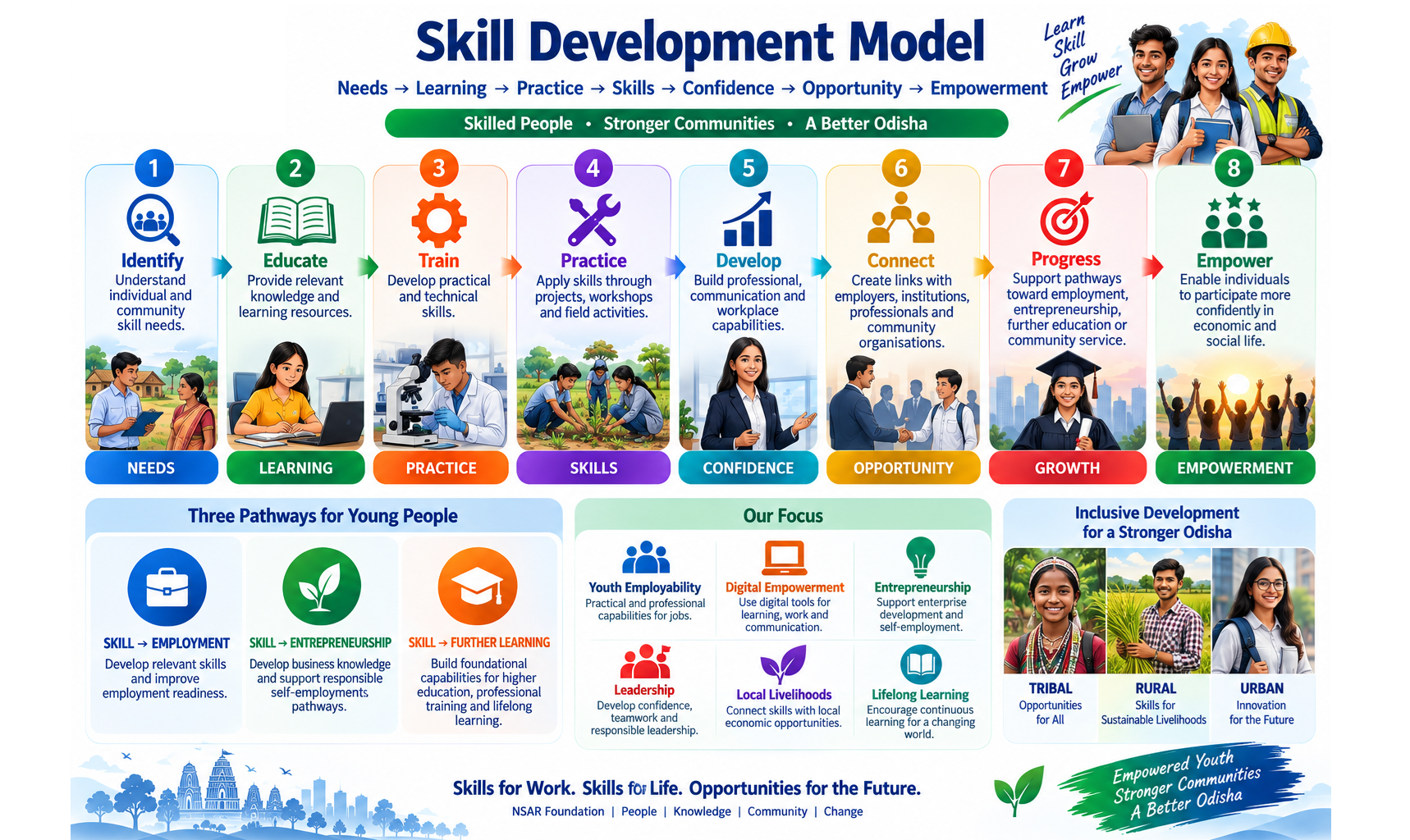
From Learning to Empowerment
The NSAR Foundation Skill Development Programme aims to help young people and community members build practical skills, professional knowledge, employability, entrepreneurship and confidence for improved livelihoods and quality of life.
8-Step Skill Development Model
A structured pathway from identifying needs to building skills, connecting opportunities and supporting empowerment.
Identify
Understand individual and community skill needs, interests, abilities and employment requirements.
Educate
Provide relevant knowledge, learning resources, foundation skills and digital capabilities.
Train
Develop practical and technical skills through structured, relevant training.
Practice
Apply learning through projects, workshops, practical activities and field experience.
Develop
Build professional communication, workplace, leadership and interpersonal capabilities.
Connect
Create links with employers, institutions, professionals and community organisations.
Progress
Support pathways toward employment, entrepreneurship, further education or community service.
Empower
Enable individuals to participate more confidently in economic and social life.
Three Pathways for Young People
Skill development can support different pathways according to individual goals and available opportunities.
Skill → Employment
Develop relevant skills and improve employment readiness through practical and professional preparation.
Skill → Entrepreneurship
Develop business knowledge and support responsible self-employment and enterprise pathways.
Skill → Further Learning
Build foundational capabilities for higher education, professional training and lifelong learning.
Our Focus
Building capabilities that support employment, entrepreneurship, leadership, local livelihoods and lifelong learning.
Youth Employability
Building practical and professional capabilities relevant to employment.
Digital Empowerment
Helping young people use digital tools for learning, work and communication.
Entrepreneurship
Encouraging informed enterprise development and responsible self-employment.
Leadership
Developing confidence, teamwork and responsible leadership capabilities.
Local Livelihoods
Connecting skills with local economic opportunities and community resources.
Lifelong Learning
Encouraging continuous learning as technologies, occupations and social needs change.
From Training to Quality of Life
Skill development is more than obtaining a certificate. It is about building knowledge, practical abilities, confidence and opportunities for meaningful participation in education, employment, entrepreneurship and community life.
NSAR Foundation Approach
Connecting education, skills, science, digital learning, research and community engagement to support inclusive human development and sustainable community progress.
Our Vision
“To create opportunities for young people to learn relevant skills, develop confidence, pursue meaningful livelihood pathways and contribute to stronger and more resilient communities.”